
Understanding subcultures
Many organisations try to define day-to-day culture at an enterprise level (at the top), then try to force feed it to employees. They wonder why, having defined a set of values or behaviours, launched it during a virtual event, circulated the presentation via email and updating everyone’s desktop picture and background with the chosen words, they are not practiced in the way that they expect?
They try to plug this gap by appointing culture champions - people strategically placed across the business - to uphold and educate, but this typically fails too, despite the best intentions of those who have volunteered.
This activity is well-meaning, but it strikes at the heart of the problem most have when trying to instil a high-performance culture. If you’re being cynical you could argue that leaders want to spend the least amount of time and money to create something that they can put on their website or LinkedIn page! That has been shared with me by disgruntled employees more than once.
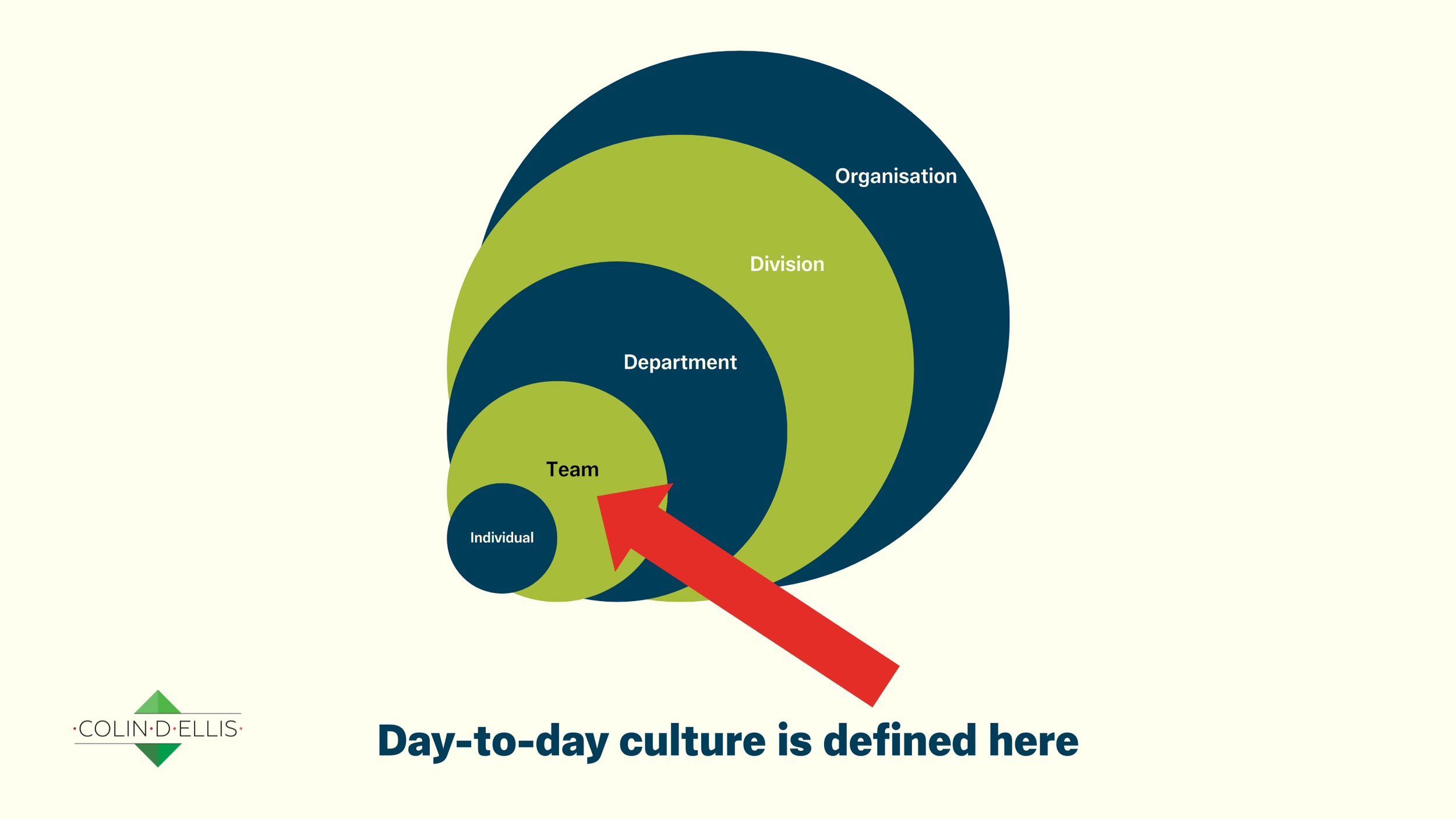
I like to believe however, that there is a genuine desire to build something that’s consistently good. However, this is only possible through an acknowledgement of the fact that day-to-day culture is built at a team-level, not at the top.
Here’s how the culture pieces fall into place.
Purpose and vision are set by the leaders of the organisation. This is important as strategy is the mechanism through which both of these things are achieved, which is created by senior managers. The goals that strategies generate indicate the kind of culture required for success. This gives meaning to work and provides employees with a north star to aim for when it comes to culture definition.
Values are the way that the organisation generates consistency around the way that work gets done, i.e. ‘we all work towards these principles’. Given that we want everyone to work in these ways, the definition of values should be a collaborative exercise between employees - led by a skilled facilitator - to ensure that what’s defined is not only representative of the kind of culture the organisation requires to achieve its goals, but also one people actually want to be part of.
Having facilitated many of these sessions I can tell you that when done well it generates immediate cultural accountability. Employees want agency over their conditions and they take great pride in upholding what they have defined.

However, the behaviours required to demonstrate the values will differ from team to team and need to be defined by managers, this is usually where the culture definition process breaks down. For example, the behaviours required by the finance team to do their work, might be very different from the behaviours required by the sales team. Each needs to ascertain what’s required of them to maintain consistency of work, as well as an adherence to the company's values.
These subcultures, or teams within the organisation, rely on the values for collaboration and to ensure that the language around culture is consistent. They also ensure that when the company talks about its culture, it is talking about all teams, not just leadership perception of what it should be.
As I’ve spoken about before, subcultures are the catalyst for organisational success and they are defined and driven by middle managers. This means that managers not only need the skills to be able to understand and define culture but that they need to spend time every year working with their team to do so.
This is exactly the kind of activity that should be taking place during annual team-building days. Yet too often, these events do nothing to engender greater collaboration, creativity or a commitment to behave in ways that generate high-performance across the organisation.
When they do, everything - and I do mean everything! - changes. Not only do managers feel more confident, but employees feel more empowered too.
Accountability and feedback becomes easier as they have defined standards to hold themselves to and continual improvement happens organically as people are invested in improving the culture they have created, every single day.
Values are consistently applied and culture not only becomes easier to talk about, it becomes easier to ‘do’.
Senior leaders can easily recognise the managers with the best subcultures as it’s represented in their results. This motivates them to become role models for the behaviours that they wish to see across the rest of the organisation (including their own team!) and performance across the board increases.
In my own work I’ve seen it increase up to threefold in just three months. This was made possible through manager education and employee agency. Yes, it takes a little longer to educate managers and yes, this costs money.
However, the gains can be so great - productivity increases by up to 20%, retention increases by 50%, increased psychological and physical safety, improved quality, more sales, improved reputation and so on - it’s money and time worth spending.
Anyone can be the creator of their own culture, yet, most cultures just happen. It’s not a deliberate choice to build something and write it down in order to achieve a result. It’s driven by the best or worst employee every day and before you know it good people are leaving for the promise of something better.
When the power of subcultures are understood, built and leveraged then the results are transformative. Not only productively and financially, but also on employee happiness too. That’s something that has to be worth investing in.
